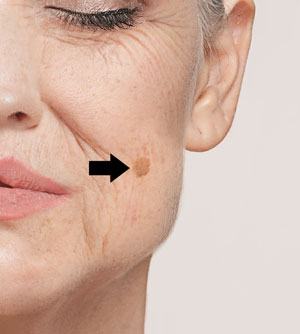
What are Lentigines?
Lentigines (singular: Lentigo) are benign (non-cancerous), flat, brown spots on the skin caused by an increased number of melanocytes (melanin-producing cells). Melanin is the pigment that gives skin, hair, and eyes their color. Lentigines are commonly known as “liver spots” or “age spots” and typically appear on areas of the skin exposed to the sun.
What are the Causes of Lentigines?
Lentigines are caused by an increased number and activity of melanocytes, the pigment-producing cells in the skin. The most common cause is chronic sun exposure, which stimulates excess melanin production and leads to the formation of solar or actinic lentigines, especially on sun-exposed areas such as the face, hands, and shoulders. Aging also contributes, as years of accumulated ultraviolet (UV) damage result in pigmentation changes. In some individuals, genetic factors play a role, and lentigines may appear as part of inherited conditions like Peutz-Jeghers syndrome, LEOPARD syndrome, or Carney complex. Additionally, certain medications and light-based therapies, such as PUVA treatment, can induce lentigo formation. Less commonly, radiation exposure, phototoxic drugs, or hormonal influences may also trigger the development of lentigines.
What are the Common Types of Lentigines?
The common types of lentigines include simple lentigines, solar lentigines, ink-spot lentigines, PUVA lentigines, and those associated with genetic syndromes.
- Simple lentigines appear in childhood and are not related to sun exposure.
- Solar lentigines, also known as age spots, develop in older adults due to long-term sun exposure and are common on the face, hands, and arms.
- Ink-spot lentigines are small, dark, irregular spots that appear after intense sun exposure.
- PUVA lentigines develop after prolonged light therapy with psoralen and ultraviolet A radiation.
- Additionally, lentigines may occur as part of inherited conditions such as Peutz-Jeghers syndrome, LEOPARD syndrome, and Carney complex, where they are often widespread and appear on the face, lips, and body.
What Does Diagnosis of Lentigines involve?
Diagnosis of lentigines usually involves a clinical examination of the skin by a dermatologist. The doctor assesses the appearance, color, and borders of the spots and may use a dermatoscope to view pigment patterns more clearly. In uncertain cases, a skin biopsy may be performed to confirm the diagnosis and rule out conditions like melanoma (a type of skin cancer) or other pigmented lesions.
How are Lentigines Treated?
Lentigines are usually harmless and do not require medical treatment unless for cosmetic reasons. Treatment focuses on lightening or removing the pigmented spots. Common options include topical bleaching agents such as hydroquinone, retinoids, or azelaic acid to gradually fade pigmentation. Chemical peels using glycolic acid or trichloroacetic acid can help exfoliate the skin and reduce dark spots. Laser therapy and intense pulsed light (IPL) are effective for targeting deeper pigment and achieving faster results. Cryotherapy, using liquid nitrogen, can also be used to destroy pigmented cells in localized spots. Alongside treatment, sun protection with broad-spectrum sunscreen is essential to prevent recurrence and the formation of new lentigines.
For more information about our services or to schedule an appointment, click here to request an appointment online. We’ll respond to you as soon as possible.